
What Lamar County Deeds Convey
Recording for Lamar County runs through the Lamar County Probate Office. The office accepts deeds and other land instruments. A deed names the parties, describes the land, and states the interest being transferred. The form of the deed matters. Warranty, quitclaim, and similar types carry different promises from the transferor. Each changes the work needed to confirm a sound chain of title.
| Deed Type | What It Does | Common Use |
|---|---|---|
| Warranty deed | Conveys the stated interest with title promises written in the instrument | Conventional sale |
| Quitclaim deed | Conveys whatever interest the grantor holds without the same promises | Family transfer or chain cleanup |
| Executor or fiduciary deed | Transfers land under authority from an estate or court process | Death-transfer or estate administration |
| Tax deed | Documents a transfer arising from a tax-sale process | Tax-delinquent land |
| Easement instrument | Grants a stated use or access right rather than full ownership | Road, utility, or access rights |
Mortgages, releases, liens, restrictions, and rights-of-way often sit alongside Lamar County deed records. They do different work. A mortgage or lien burdens an interest rather than conveying it. Match each instrument by its parties and legal description. A shared surname alone proves nothing.
Lamar County Probate's Online Window
The county points to the ING Probate land-record portal. Documents filed through Probate from October 3, 2022 forward are available through its document service. That coverage date describes the online window. It is not the start of Lamar County deed records. The landing page separates land records from probate cases. It also offers account access, instructions, and a pay-per-document route.
The vendor describes party-role, date-range, book/page, instrument-type, sort, cross-reference, cart, and download controls. Prices are listed too. Confirm those details inside the live Lamar session. The portal terms bar automated scraping.
| Search clue | How to use it | Local caution |
|---|---|---|
| Grantor or grantee | Try surnames, entities, initials, and party roles | Punctuation and joint names can hide a match |
| Book and page | Use the CAMA reference to target an instrument | Confirm it against the legal description |
| Recording date | Narrow a known transfer period | Execution and recording dates may differ |
| Instrument type | Separate deeds from releases, easements, and liens | Exact Lamar choices require a live check |
Note: A search that comes up empty before the stated coverage date signals the wrong channel, not a missing deed. The record itself may still sit in the probate office.
See the Lamar County Deed Portal
The officially linked Lamar Probate service opens on a portal landing page rather than a free deed image. Its visible choices help you tell land records apart from probate case records.
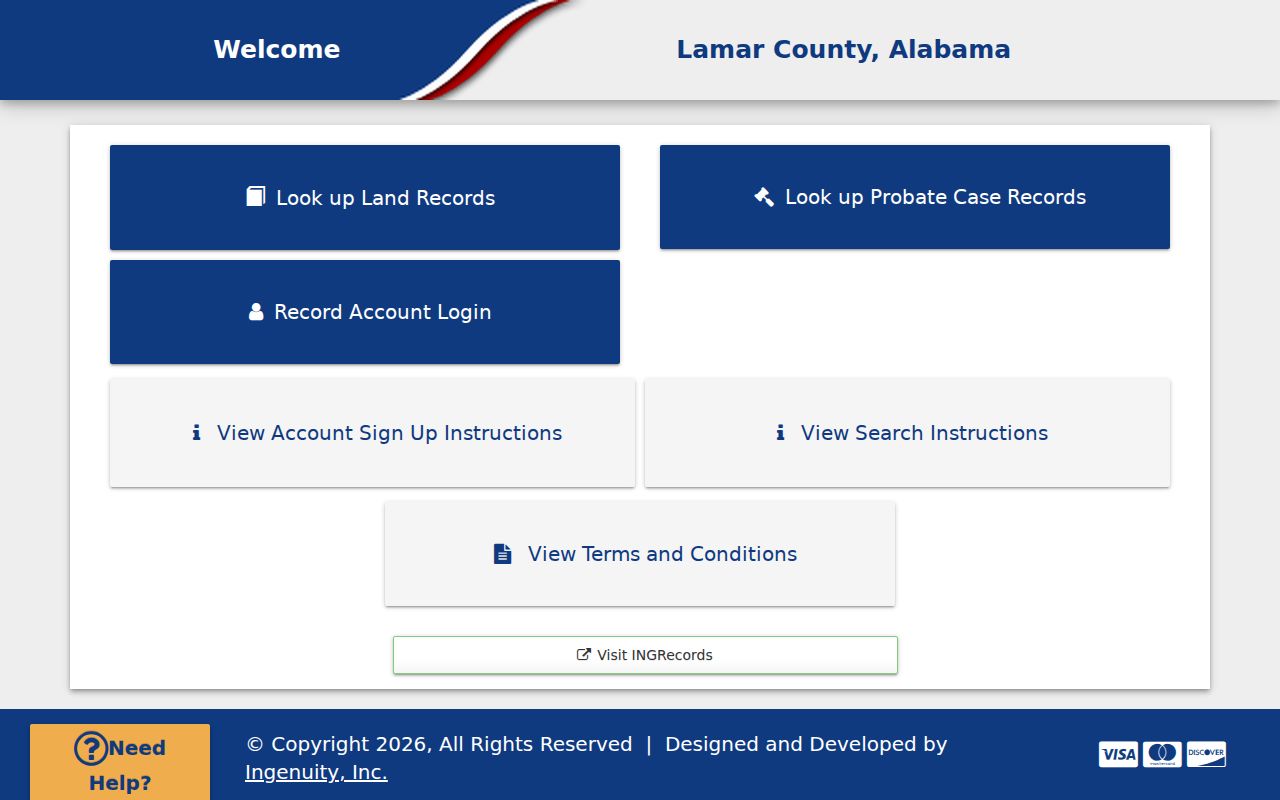
The page lays out the available routes and the account boundary. It does not show whether any specific document or image is indexed. The portal's INGRecords service also describes county-record searches and document purchasing at the vendor level.
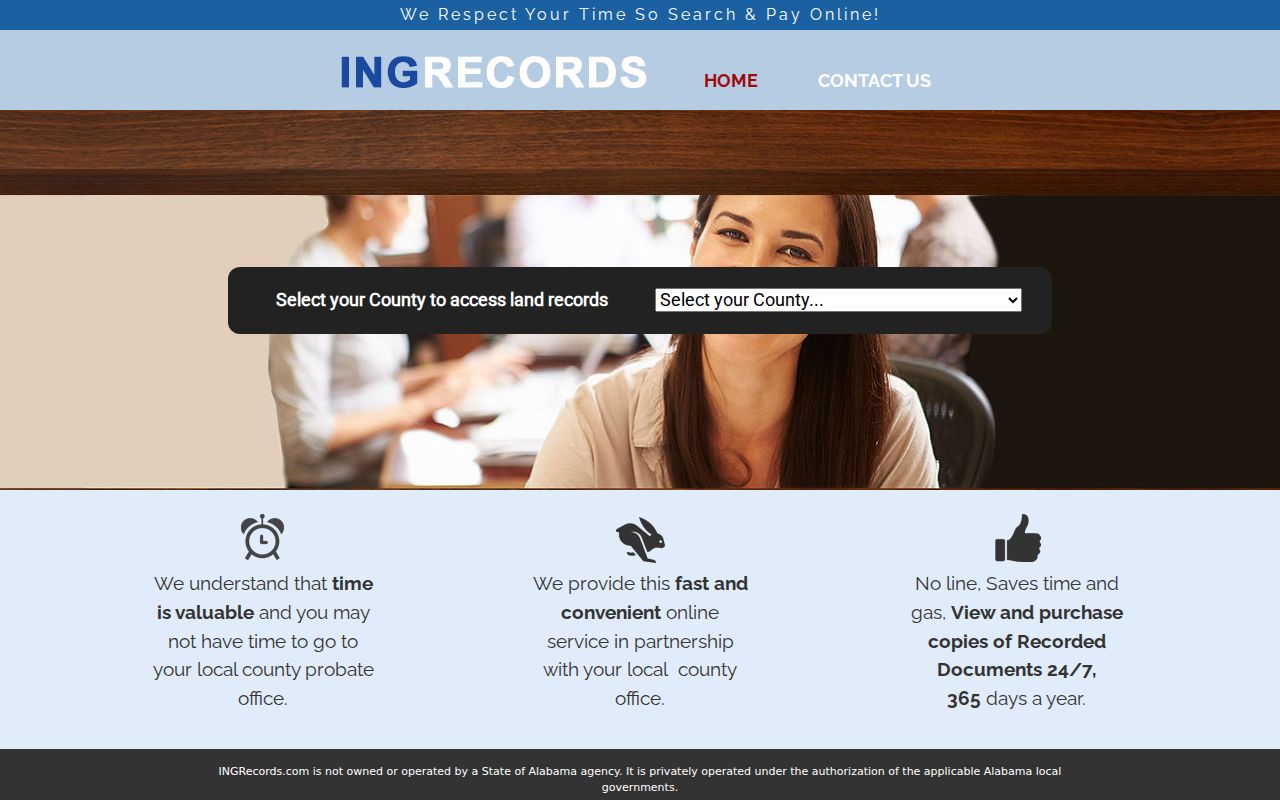
That vendor page explains the broader purchasing route. Lamar-specific fields, document availability, and charges still need confirmation inside the county portal itself.
Follow Lamar County's Grantor-Grantee Chain
A grantor gives an interest. A grantee receives it. The chain of title is the ordered set of transfers for one piece of land, and each link rests on the instruments and their legal descriptions. A current CAMA card can supply a book/page lead. The recorded instruments still carry the chain.
- Find the current conveyance by searching the recorded grantee or the CAMA book/page lead.
- Copy its grantor, grantee, legal description, book/page or filing reference, and recording date.
- Search that grantor as a prior grantee, then compare the land description before stepping back.
- When the web window ends, continue at Probate, FamilySearch, or ADAH rather than ending the chain.
- Grantor
- The party transferring the stated interest.
- Grantee
- The party receiving the stated interest.
- Chain of title
- The connected sequence of conveyances for the same land.
- Book and page
- A recorded-document reference that can bridge CAMA and Probate.
A name match alone is weak evidence. Estates, trusts, businesses, abbreviations, and duplicate names can all break a name-only chain in Lamar County deed records. The legal description and any referenced prior instrument are the stronger connectors.
Jones, Sanford, Then Lamar
Early Lamar County deed records live under three county names. The county began as Jones County in 1867. It was reestablished as Sanford County in 1868 and took the name Lamar County in 1877. Ignore that history. A surname search that works in a later book may fail in an older catalog.
The FamilySearch deed catalog reflects the same timeline. It lists Jones/Sanford Deeds A for 1867 to 1868. Sanford Deeds B covers 1868 to 1870. Later numbered volumes follow, along with Lamar volumes after the renaming. The collection runs through 1904. Check the exact reel and volume before citing it.
Three-name search. Repeat a historic surname and land-description search under Jones, Sanford, and Lamar when the date crosses the county's renamings.
Older Lamar County Deed Books
Deeds predating the portal have several routes. Start at the Probate counter or call 205-695-9119. The office sits in the Courthouse Annex at 205 Butler Circle SW in Vernon. Ask about the instrument type, parties, and approximate date. Also ask about the book/page if known, and whether you need a plain or certified copy.
For historical digging, use the FamilySearch catalog and the Alabama Department of Archives and History county microfilm database. The Secretary of State land-record guidance adds name, book, and township-range-section routes. It notes that post-1950 material may sit with county Probate. The county publishes no public-library deed collection.
Note: Microfilm and catalog images are research aids. Probate remains the route for a current certified Lamar County deed copy.
Match Lamar County Land Descriptions
Lamar CAMA can display a segmented parcel number, account number, section-township-range, acres, and a deed reference. Those fields make useful crosswalks. The deed's legal description still controls the tract match. Rural tracts may use quarter-sections and metes and bounds. City land often turns on lot and subdivision terms.
A Sulligent tax card shows why the full text matters. Its subdivision field reads "NON APPLICABLE," while the legal description names Lot 7 in Norton Estates with section, township, and range. The Lamar CAMA search starts lookups by owner, address, parcel, book/page, acreage, value, or land-grid fields. It does not replace the recorded description.
Lamar Deed Tax Clues
Alabama recordation tax offers clues about the filing type and the basis stated for tax. It does not establish current value or ownership by itself. State guidance sets mortgage tax at $0.15 per $100 of indebtedness and deed tax at $0.50 per $500 of value under Alabama Code sections 40-22-1 through 40-22-12. Read the document before drawing a conclusion from a stamp.
Consideration stated in a Lamar County deed also needs context. A family transfer, estate conveyance, corrective instrument, or quitclaim may not reflect an open-market sale. The county card shows no verified sale-price field. Keep recorded consideration separate from the assessor's appraised value and the tax roll's assessed figure.
A deed involving an LLC calls for an extra step. Match the grantee's exact legal name through the Alabama business entity search. An officer or registered-agent address does not prove that a person owns the land or the entity.
Request a Lamar County Deed Copy
Recent deed images may be available through the ING account or the pay-per-document path. Confirm current image and certified-copy fees with Probate before paying. At the counter, state whether you need inspection, a plain copy, or certification. Phone first before mailing. That call confirms the reference, total fee, accepted payment, and return method.
The local procedure covers county administrative requests. Alabama residents use the standard form. Provide reasonable detail and proof of residency. Submit as directed. Lamar County does not acknowledge unsolicited electronic requests. Estimated administrative fees may be due before release. Searches expected to exceed eight hours may require advance payment.
Recorded, not guaranteed. Lamar County deed records show filed instruments, not a title opinion. Unrecorded interests, priority issues, or defects can require an attorney or title professional.
A certified copy proves what the custodian copied. It does not promise clear title. For a purchase, boundary dispute, or lien-priority question, pair the recorded deed records with a professional title search and, when boundaries matter, a survey.