
Fields in Lamar County Tax Records
The Lamar County Revenue Office handles both assessment records and tax administration, while deeds live with Probate. One county CAMA card pulls several values onto a single screen. Each field, though, answers a different question about the parcel.
| Field | What It Shows | Where |
|---|---|---|
| Land and building values | Separate appraisal components | CAMA detail or card |
| Appraised or total market | County appraisal field, not a sale price | CAMA result |
| Assessed value | Tax basis after Alabama classification | CAMA card and Revenue |
| Exemption and current use | Relief or special valuation shown for the account | Revenue record |
| Annual tax and history | Tax-year figure and selected past payments | CAMA card; confirm with Revenue |
Alabama starts with classification. The class applied to appraised value produces the assessed value, and millage is then charged against that figure. Exemptions can shrink the final number further. Recorded consideration, appraised value, assessed value, and any unpaid balance are four separate amounts, and confusing them leads people astray.
Search Lamar County CAMA Tax Fields
The Lamar GIS/CAMA search organizes lookups into Basic, Parcel, Land, and Building routes. Fields span account, a segmented parcel number, owner, physical address number and street, acreage range, value range, district, use, exemption, subdivision, deed book and page with date, and section-township-range. No single field is required across every route. A result typically displays account, parcel, owner, situs, owner mailing address, district, land and improvement values, total market value, acres, deed reference, exemption, yearly tax, and subdivision. Open the detail view and the property card as well. Search availability and refresh timing can change without notice. The Lamar Public GIS landing page is the official Revenue-linked entry point to the portal.
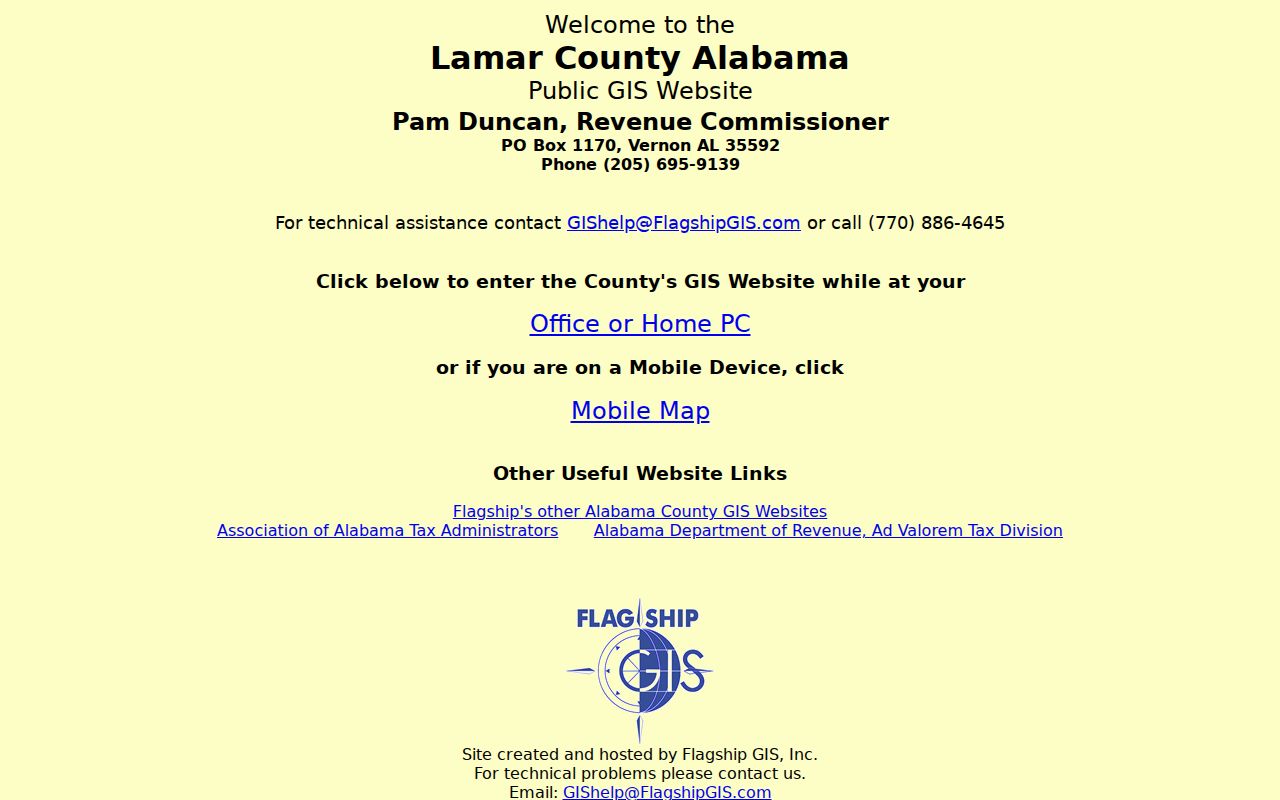
The image highlights the portal's search route. It is not a live balance or a full tax statement.
Lamar County's Card Value Triangle
One Sulligent-area card splits its value cleanly. It shows $2,980 in land and $119,280 in buildings, for an appraised total of $122,260. The 2024 annual tax shown is $894.25. A fourth number like that is not simply a second name for appraised value. That is exactly why the distinction matters. A rural Lamar card lists a mobile home and carport as separate improvements. Another rural card, owned by an entity, shows a Mississippi mailing address. It lists no physical address at all. Details vary from parcel to parcel. The formula never does: classify the property, calculate assessed value, apply millage, then subtract exemptions. Note: A CAMA annual-tax figure reflects the assessment year, not today's unpaid balance or payment status.
Look Up a Lamar County Tax Bill
Start with the CAMA account and parcel number. Then move to the county-linked online payment and receipt service. Its page discloses an online-payment fee and offers reprint options, including a 2026 receipt search. The fee amount and the dynamic lookup fields live in the service itself. Confirm them there. The Lamar online tax-payment page serves as the county-linked entry point. It handles payments and receipt searches.
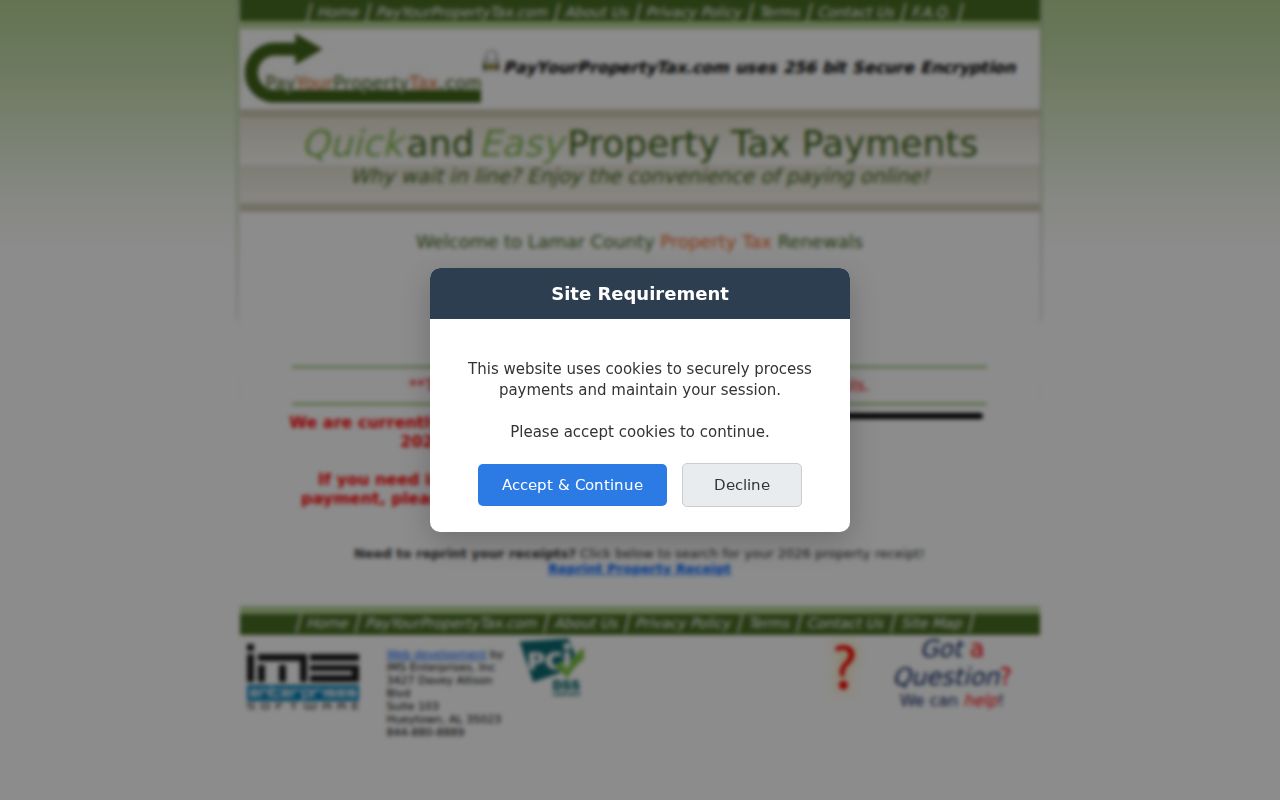
The image highlights the payment and receipt route. A taxpayer still needs the live flow or a call to Revenue to confirm a parcel's balance, fee, and delinquency status.
- Find the parcel and account in CAMA; preserve both identifiers exactly.
- Open the county-linked payment service and check the account or receipt route available.
- Compare the tax year, exemption, and annual-tax field to the Revenue record.
- Call 205-695-9139 to confirm balance, payment, delinquency, or transfer lag.
- Assessed value
- The classified value to which millage applies.
- Millage
- The rate used to calculate tax from assessed value.
- Homestead exemption
- Relief that may apply to a qualifying homestead.
- Tax lien
- A legal claim arising from unpaid property tax.
Lamar County Tax Dates and Transfers
Per the Alabama Department of Revenue, property taxes come due October 1. They turn delinquent after December 31. The same guidance carries a warning for buyers. A purchaser can stay responsible for a bill even while the tax record still shows the former owner's name. Ownership and tax administration move on separate clocks. After buying property, record the deed with Probate and assess the property through Revenue. Report additions or improvements, and keep the mailing address current. A recorded deed can outrun the assessment roll. Use the deed to prove the conveyance and Revenue for current tax administration.
Lamar County Exemptions and Current Use
The state's Alabama property-tax assessment resource walks through property classes, homestead relief, and millage. It also covers assessed value and current-use valuation. An exemption code on a web card does not establish eligibility by itself. Ask Lamar County Revenue what the code means and what proof, deadline, or application applies. Current use can value qualifying property under a statutory use method. This happens rather than under ordinary appraisal assumptions. When questioning a bill, preserve the classification, exemption, current-use field, tax district, and assessment year. Any one of them can change the outcome.
Read Lamar County Tax Card History
A property record card can preserve selected payment history, mapping references, and land elements. It can also show building components and improvements alongside the current assessment year. One Lamar County rural card shows payments for 2020, 2021, and 2022. It also carries a 2024 annual-tax field. Past entries guarantee neither a complete year-by-year record nor a current paid status. Use that history to frame a precise question. Give Revenue the account, parcel, year, and the field in doubt. Ask what the amount actually is. It could be a levy, a payment, an adjustment, or a delinquent balance. It could also be a receipt. The Revenue Office publishes no email or fax order route for parcel-specific tax records. Call first or write to PO Box 1170 after confirming procedure. For administrative material sought under the county's public-record process, the request must be reasonably specific. Lamar County requires its standard form, proof of Alabama residency, and the stated submission method. The county says unsolicited electronic requests receive no acknowledgment. Estimated administrative fees may also apply before fulfillment.
Lamar County Delinquency and Tax Sales
An unpaid balance can trigger a lien and eventual tax sale. The annual figure shown in CAMA, though, proves neither one. Check the account with the Revenue Office first. Then search Probate records for any certificate, deed, or redemption instrument filed against the parcel. Litigation sometimes follows a sale, so court filings can matter too.
For property the state now holds, the Alabama DOR state-held land process explains quotes, applications, payments, certificates, and deeds. It covers quotes and applications. It also handles payments, certificates, and deeds. The department cautions that a tax certificate or tax deed alone does not convey clear title. A certificate alone is not enough. A tax deed alone is not either. Lamar County publishes no current auction calendar, so ask Revenue directly about upcoming sales.
Tax sale is not clear title. Verify the parcel, process, redemption status, and recorded instruments before treating any certificate or deed as ownership proof.
Lamar County Tax Access Channels
Online tax work starts with CAMA, which ties into the payment and receipt service. The Revenue Department handles parcel questions by phone or in person. Staff can confirm a parcel crosswalk, an assessment year, an exemption, a payment, a delinquency, an address change, a split, a combination, or an improvement report. Call 205-695-9994 for appraisal questions. Revenue's main line is 205-695-9139.
Mail goes to the Revenue Office at PO Box 1170, Vernon, Alabama 35592, once staff confirms what to include. Lamar County publishes no historical tax rolls online. For an older roll, ask the courthouse, FamilySearch, or ADAH what survives and how it can be inspected. A missing online year does not mean the office holds no record.
Contest a Lamar County Assessment
Start at the Revenue Office. Verify the parcel number, classification, land and improvement details, exemptions, and the assessment notice date. Build a file with the deed, photographs, measurements, repair estimates, and comparable sales. Any record showing a clerical error belongs there too. A strong challenge names the disputed field. A general objection to the tax total will not carry the protest.
Under the Alabama DOR protest guidance, a written Board of Equalization protest must reach the board within 30 calendar days of the notice date. If no notice arrived, the deadline runs differently. It runs 30 days after the board finishes reviewing county assessments. Confirm the operative date with Lamar County Revenue before filing.
Protect the protest window. Alabama guidance uses a 30-day rule tied to notice or completion of review. Confirm and file with the proper board promptly.
Keep proof of delivery and a copy of everything filed. A value protest is not a payment dispute, exemption application, deed correction, or boundary fight. Route each issue to the office that actually holds the record.